
24K vs 22K vs 18K Gold | Value, Prices & Buying Guide
When comparing 24K vs 22K vs 18K gold, the best choice depends on your goal: 24K gold is best for pure investment and wealth preservation, 22K gold offers the best balance between jewelry and resale value, and 18K gold is ideal for durable, affordable daily-wear jewelry. Understanding these differences is essential for buyers and investors in Africa and globally, especially in 2026, when gold prices fluctuate daily based on international spot rates.
Gold purity directly affects value, durability, resale potential, and investment security, making it critical to choose the right karat before purchasing. Because gold is considered a high-value financial asset (YMYL category), buyers must rely on verified purity standards, certified dealers, and transparent pricing structures when making decisions.
What Is 24K, 22K, and 18K Gold?
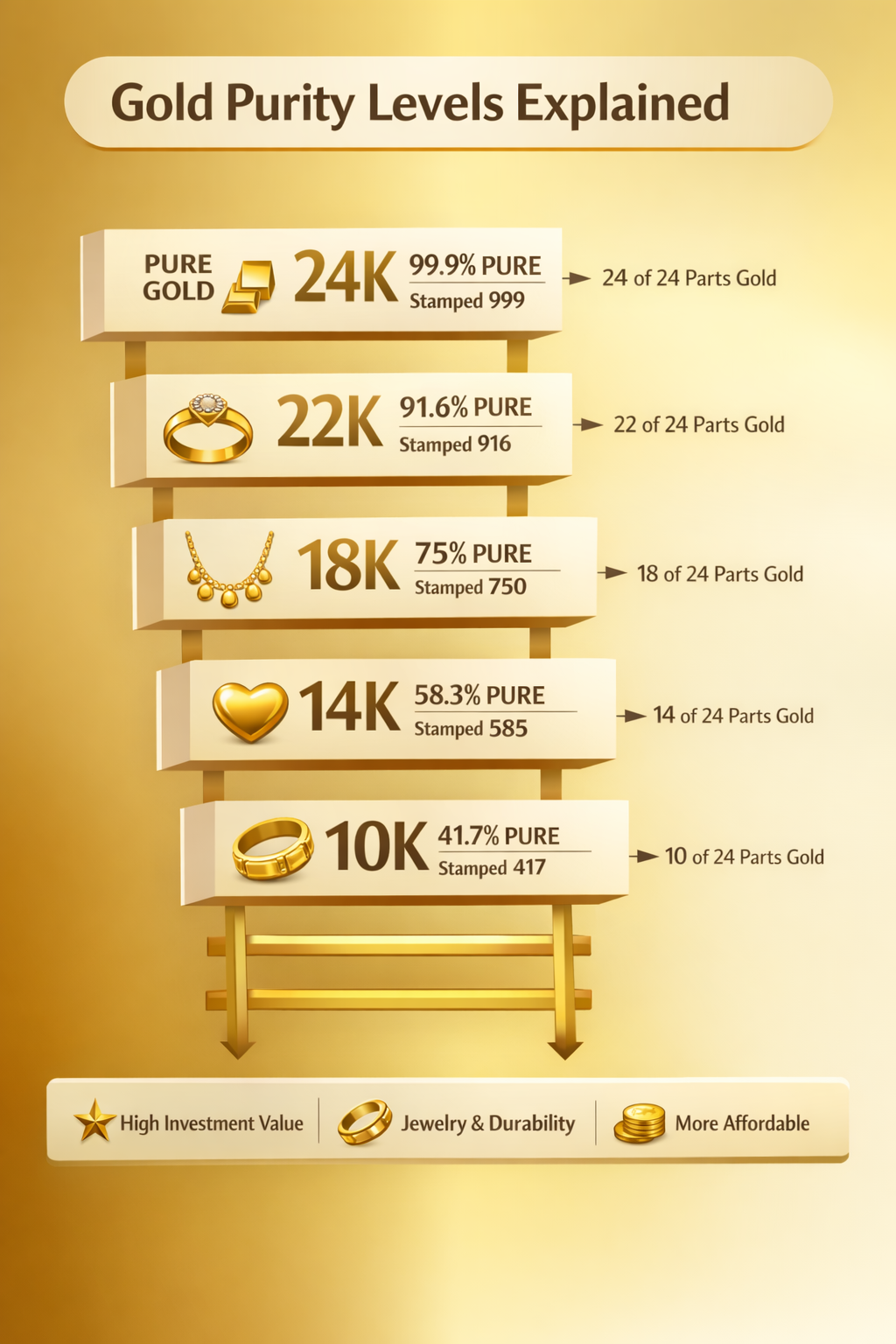
24K Gold: 24K gold is the purest form of gold, with 99.9% purity, making it the most trusted option for investors and collectors seeking long-term wealth preservation in Africa; its high resale value and global recognition as bullion make it ideal for gold bars, coins, and investment-grade jewelry, although its softness means it can easily scratch or bend, limiting its use for daily-wear jewelry.
22K Gold: 22K gold contains 91.6% pure gold combined with a small amount of alloy, which gives it greater durability than 24K gold while retaining most of its investment value; this makes 22K gold perfect for high-end jewelry that holds its resale value, weddings, and cultural ornaments, offering a balance between purity, strength, and market liquidity, although it is slightly less ideal for pure bullion investment compared to 24K gold.
18K Gold: 18K gold has 75% gold content mixed with stronger metals, which makes it highly durable, stylish, and more affordable than 24K or 22K gold, making it ideal for fashion jewelry, daily-wear rings, bracelets, and pendants; however, due to its lower purity, its resale and bullion investment value are lower, and it is better suited for consumers prioritizing design, affordability, and durability rather than maximum investment returns.
24K, 22K & 18K Gold Prices Across Major African Markets (2026)
Note: Prices are estimated retail ranges in USD and may vary based on the international gold spot price, exchange rates, dealer premiums, taxes, and local market conditions.
| Country | Average 24K Price (USD/g) | Gold Type | 1g | 5g | 10g | 50g | 100g | 1kg | Best For |
| Uganda | $131.50 | 24K | $129–134 | $645–670 | $1,290–1,340 | $6,450–6,700 | $12,900–13,400 | $129,000–134,000 | Bullion, wholesale trading |
| 22K | $118–123 | $590–615 | $1,180–1,230 | $5,900–6,150 | $11,800–12,300 | $118,000–123,000 | Jewellery | ||
| 18K | $96–101 | $480–505 | $960–1,010 | $4,800–5,050 | $9,600–10,100 | $96,000–101,000 | Designer jewellery | ||
| Kenya | $132.50 | 24K | $130–135 | $650–675 | $1,300–1,350 | $6,500–6,750 | $13,000–13,500 | $130,000–135,000 | Bullion and jewellery |
| Ghana | $134.50 | 24K | $132–137 | $660–685 | $1,320–1,370 | $6,600–6,850 | $13,200–13,700 | $132,000–137,000 | Investment bullion |
| South Africa | $133.50 | 24K | $131–136 | $655–680 | $1,310–1,360 | $6,550–6,800 | $13,100–13,600 | $131,000–136,000 | LBMA bullion, Krugerrands |
| Tanzania | $131.00 | 24K | $129–133 | $645–665 | $1,290–1,330 | $6,450–6,650 | $12,900–13,300 | $129,000–133,000 | Bullion trading |
| Nigeria | $133.00 | 24K | $130–136 | $650–680 | $1,300–1,360 | $6,500–6,800 | $13,000–13,600 | $130,000–136,000 | Jewellery and bullion |
| Ethiopia | $130.00 | 24K | $128–132 | $640–660 | $1,280–1,320 | $6,400–6,600 | $12,800–13,200 | $128,000–132,000 | Retail gold market |
Market Comparison at a Glance
| Country | Typical 24K Price Level | Market Characteristics |
| Uganda | Competitive | Regional refining and wholesale trading hub |
| Kenya | Competitive | Active bullion and jewellery market |
| Ghana | Slightly higher | Major gold producer with strong export sector |
| South Africa | Slightly higher | Established bullion market and renowned refineries |
| Tanzania | Competitive | Mining and regional gold trading |
| Nigeria | Moderate to high | Large consumer and jewellery market |
| Ethiopia | Competitive | Growing domestic jewellery market |
Important Note
These figures are illustrative price ranges rather than official market quotes. Actual buying and selling prices depend on:
- The live international gold spot price (XAU/USD).
- Local currency exchange rates.
- Dealer premiums and fabrication costs.
- Taxes, import duties, and regulatory requirements.
- Product type (bullion bar, coin, jewellery, or dore bar).
- Order size and payment method.
This disclaimer is important for accuracy because fixed price ranges can quickly become outdated as the gold market moves.
24K vs 22K vs 18K vs 14K Gold: Quick Comparison
Place this table near the top of your article to help readers quickly compare the most common gold purities.
| Gold Type | Gold Purity | Pure Gold Content | Best Use | Investment Value | Typical Resale Value | Recommendation for U.S. Buyers |
| 24K Gold | 99.9%–99.99% | Nearly 100% pure gold | Investment bars, bullion coins, long-term wealth preservation | ⭐⭐⭐⭐⭐ Excellent | Highest, closely tracks the global gold spot price | Best choice for investors seeking physical bullion and portfolio diversification. |
| 22K Gold | 91.67% | 22 parts gold, 2 parts alloy | Wedding jewellery, high-purity coins, collectible pieces | ⭐⭐⭐⭐ Very Good | High, although jewellery may include making charges | Suitable for buyers who want both high gold content and wearable jewellery. |
| 18K Gold | 75.0% | 18 parts gold, 6 parts alloy | Luxury jewellery, engagement rings, watches | ⭐⭐⭐ Moderate | Moderate, based mainly on gold weight and purity | Recommended for premium jewellery rather than investment purposes. |
| 14K Gold | 58.3%–58.5% | 14 parts gold, 10 parts alloy | Everyday jewellery, wedding bands, fashion accessories | ⭐⭐ Fair | Moderate to low, depending on condition and gold price | Ideal for everyday wear due to its durability and affordability. |
| 10K Gold | 41.67% | 10 parts gold, 14 parts alloy | Budget jewellery and durable daily wear | ⭐ Low | Lower because of reduced gold content | Suitable for buyers prioritizing durability and lower cost over gold purity. |
Key Takeaways for U.S. Buyers
- Choose 24K gold if your primary goal is long-term investment, wealth preservation, or owning investment-grade bullion.
- Choose 22K gold if you want jewellery with a high gold content while retaining good resale potential.
- Choose 18K gold for luxury jewellery that balances purity, appearance, and durability.
- Choose 14K gold if you need durable jewellery for everyday wear at a more affordable price.
- Choose 10K gold only if budget and durability are more important than maximizing gold content or investment value.
Buying Tip: If you’re purchasing gold as an investment in the United States, prioritize 24K bullion bars or coins from recognized refiners or government mints. These products typically have the highest market acceptance, transparent pricing, and the strongest resale liquidity.
22K vs 18K Gold: Investment Comparison in Africa
| Investment Factor | 24K Gold (99.9%) | 22K Gold (91.6%) | 18K Gold (75%) |
| Best For | Long-term wealth preservation | Jewelry + investment balance | Affordable entry-level investment |
| Purity Level | 99.9% pure gold | 91.6% pure gold | 75% pure gold |
| Investment Potential | Excellent | Very Good | Moderate |
| Liquidity in African Markets | Very high (globally recognized bullion) | High (strong jewelry resale market) | Moderate (mainly jewelry resale) |
| Resale Value | Highest resale value | High resale value | Lower resale value compared to 22K & 24K |
| Durability | Low (very soft) | Medium (balanced strength) | High (very durable) |
| Common Form | Gold bars, coins, bullion | Wedding rings, bracelets, necklaces | Fashion rings, pendants, and daily wear jewelry |
| Capital Requirement | High initial investment | Medium to high investment | Lower initial investment |
| Market Recognition | International bullion markets | Widely accepted in Africa | Primarily the jewelry market |
| Ideal Investor Type | Long-term investors, wealth preservers | Jewelry investors, cultural buyers | First-time buyers, young investors |
Legal Considerations When Buying Gold in Africa
- Licensed Dealers Only: When buying gold in Africa, always purchase from licensed and registered dealers, as transactions with unlicensed sellers can be illegal and may result in fines, confiscation, or other penalties.
- Export Documentation: Exporting gold from countries like Uganda, Kenya, Ghana, or South Africa requires proper export permits and government clearance, especially for quantities above 1kg, to ensure compliance with local and international regulations.
- Taxes and Duties: Buyers must account for VAT, import/export taxes, and royalty fees, which vary by country, as failing to pay the correct taxes can lead to legal issues or seizure of the gold.
- Verification and Assays: Conducting proper assays and verification is critical to confirm purity and weight, as most African governments and reputable buyers require certified testing from recognized refineries before a transaction is considered legal.
- Anti-Money Laundering Compliance: Gold purchases in Africa are subject to AML and KYC regulations, requiring buyers to provide identification and proof of funds, ensuring all transactions are transparent and compliant with national financial laws.
Uses of 24K, 22K, and 18K Gold in Africa
| Gold Type | Purity Level | Primary Uses | Investment Value | Durability | Target Buyers |
| 24K Gold | 99.9% pure | Gold bars, bullion, investment coins, ceremonial gifts, commemorative medals | Very High | Low (very soft metal) | Long-term investors, wealth preservers, and institutional buyers |
| 22K Gold | 91.6% pure | Wedding rings, necklaces, bracelets, cultural ornaments, heritage jewelry | High | Medium (balanced strength & purity) | Jewelry investors, cultural buyers, high-value collectors |
| 18K Gold | 75% pure | Fashion rings, pendants, daily-wear jewelry, modern designer pieces | Moderate | High (strong & durable) | Young buyers, first-time investors, urban collectors |
Note
- 24K gold is best used for bullion, gold bars, and wealth preservation due to its maximum purity and global market recognition.
- 22K gold is ideal for high-end jewelry and cultural ornaments, offering strong resale value and durability.
- 18K gold is most commonly used for fashionable, durable, daily-wear jewelry with affordable pricing and moderate investment potential.
Certification and Hallmarking: How to Verify Gold Purity
One of the most important steps in building trust when buying gold is verifying its authenticity through official certification and hallmarking systems, which confirm the purity and legitimacy of the gold item. For example, in India, gold jewelry is certified under the BIS (Bureau of Indian Standards) Hallmarking system, which guarantees purity levels such as 24K (999), 22K (916), and 18K (750).
In the United Kingdom, the Assay Office Hallmark ensures compliance with the Hallmarking Act, verifying that the gold meets legal purity standards. Globally, buyers should look for standard purity stamps such as 999 (24K), 916 (22K), or 750 (18K) engraved on the gold piece, as these markings indicate the percentage of pure gold content and protect consumers from fraud or under-karting.
In African markets such as Uganda, Ghana, and South Africa, investors are strongly advised to purchase gold from licensed dealers and recognized refineries that provide assay certificates confirming weight and purity, as this documentation enhances resale value and ensures legal compliance.
Pricing Transparency: Understanding the Daily Spot Price
Gold prices fluctuate daily based on the London Bullion Market Association (LBMA) spot price, global demand, inflation trends, currency strength, and central bank activity, meaning that the value of 24K, 22K, and 18K gold changes in direct proportion to their purity levels. Because 24K gold contains 99.9% pure gold, it is priced closest to the daily spot rate, while 22K and 18K gold are valued according to their respective purity percentages of 91.6% and 75%.
A transparent and professional pricing method follows this widely accepted formula:
Price of Piece = (Gold Spot Price × Purity % × Weight) + Making Charges
This formula ensures buyers understand exactly how the final price is calculated, where the spot price determines base value, purity percentage adjusts for karat level, weight determines total gold content, and making charges cover craftsmanship and design costs. Transparent pricing builds buyer confidence and aligns with global bullion standards.
Citing Experts and Professional Authority
To further strengthen credibility, reputable gold dealers often rely on certified gemologists and professional jewelers when explaining purity and valuation. As noted by certified gemologist associations, “Gold purity directly determines intrinsic value, and proper hallmark verification protects both investors and consumers from financial loss.” Similarly, experienced jewelers emphasize that “Understanding karat differences and pricing formulas is essential for anyone investing in physical gold.”
By referencing certified professionals, adhering to recognized hallmarking systems, and clearly explaining pricing calculations, gold buyers and investors can make informed decisions while ensuring compliance with international standards.
Gold Purity Chart: 24K vs 22K vs 18K vs 14K Gold
| Karat (K) | Gold Purity | Decimal Fineness | Common Hallmarks | Typical Uses | Investment Suitability |
| 24K | 99.9%–99.99% | 0.999 / 0.9999 | 24K, 999, 999.9 | Investment bars, bullion coins, central bank reserves | ⭐⭐⭐⭐⭐ Excellent |
| 23K | 95.8% | 0.958 | 23K, 958 | High-purity jewellery, commemorative coins | ⭐⭐⭐⭐ Very Good |
| 22K | 91.67% | 0.9167 (916) | 22K, 916 | Wedding jewellery, Sovereign coins, Asian and Middle Eastern jewellery | ⭐⭐⭐⭐ Very Good |
| 21K | 87.5% | 0.875 | 21K, 875 | Middle Eastern and Mediterranean jewellery | ⭐⭐⭐ Good |
| 18K | 75.0% | 0.750 | 18K, 750 | Luxury jewellery, watches, engagement rings | ⭐⭐⭐ Moderate |
| 14K | 58.3%–58.5% | 0.583 / 0.585 | 14K, 583, 585 | Everyday jewellery, wedding bands | ⭐⭐ Fair |
| 10K | 41.67% | 0.417 | 10K, 417 | Affordable jewellery, class rings | ⭐ Low |
| 9K | 37.5% | 0.375 | 9K, 375 | Budget jewellery in the UK, Europe, and Australia | ⭐ Low |
How to Read the Gold Purity Chart
- Karat (K) measures the proportion of pure gold out of 24 parts.
- 24K gold is nearly pure gold (99.9%).
- 22K gold contains 22 parts gold and 2 parts alloy.
- 18K gold contains 18 parts gold and 6 parts alloy metals like copper or silver.
- The Common Stamp (such as 999, 916, or 750) is engraved on gold jewelry to verify authenticity and purity.
How do I verify gold purity before buying?
Verifying gold purity before buying is one of the most important steps in any gold transaction. Whether you are purchasing a 24K gold bar, bullion coin, gold jewellery, or dore bar, you should never rely solely on the seller’s claims. Always request independent proof of the gold’s purity and authenticity before making payment.
The most reliable method is X-Ray Fluorescence (XRF) testing, a non-destructive process that accurately measures the metal composition of a gold item without causing any damage. For high-value commercial transactions, many professional buyers also request a fire assay, which is widely regarded as the industry standard for determining the exact purity of gold.
If you are purchasing investment-grade gold bars, check that each bar has a unique serial number, the refiner’s hallmark, the weight, and the purity stamp (such as 999.9 or 99.99%). Ask the seller to provide an assay certificate or certificate of authenticity issued by the refiner or an accredited testing laboratory. Ensure that the information on the certificate matches the details engraved on the gold bar.
For gold jewellery, examine the hallmark or karat stamp, such as 18K, 22K, or 24K, and confirm the item’s weight using a calibrated digital scale. Purchase jewellery from established retailers that provide a detailed invoice showing the gold purity, weight, purchase price, and any applicable warranty.
When buying raw gold or dore bars, request documentation showing the gold’s origin, ownership, and any available assay reports. Because the purity of unrefined gold can vary significantly, laboratory testing should always be completed before the transaction is finalized.
Finally, buy gold only from reputable businesses with a physical office and verifiable business registration. Avoid sellers offering gold at prices far below the international market rate or those who refuse to allow independent testing. Taking these precautions helps ensure that you receive genuine gold with the purity and value you are paying for.
Where Can Americans Buy Certified 24K Gold?
Americans can purchase certified 24K gold from reputable bullion dealers, authorized mints, banks (where available), and licensed precious metals companies. Before buying, verify the seller’s reputation, confirm the gold’s purity, and ensure the product includes an assay certificate or authenticity documentation.
| Seller Type | Gold Products Available | Certification | Best For |
|---|---|---|---|
| Authorized Bullion Dealers | 24K gold bars, bullion coins, minted bars | Assay certificate, serial number, LBMA-recognized refiners | Individual investors and collectors |
| Online Precious Metals Dealers | Gold bars, coins, fractional bullion | Manufacturer’s certificate and secure shipping | Convenient nationwide purchases |
| Authorized Mint Distributors | Newly minted investment coins and bars | Government mint authentication | Long-term investors |
| Licensed Coin & Bullion Shops | Gold bars, bullion coins, pre-owned bullion | Purity verification and receipts | Buyers who prefer in-person purchases |
| Banks (Where Offered) | Selected investment-grade gold bars or coins | Bank-issued documentation | Institutional and high-net-worth buyers |
| Licensed Precious Metals Companies | Large bullion orders, wholesale gold bars | Assay reports, export/import documentation (where applicable) | Commercial buyers and businesses |
What to Check Before Buying Certified Gold
| Verification Item | Why It Matters |
|---|---|
| Purity Stamp (999.9 or 99.99%) | Confirms the gold is investment-grade 24K. |
| Assay Certificate | Verifies the weight and purity of the gold. |
| Serial Number | Allows individual bullion bars to be identified and matched to their certificate. |
| Refiner’s Hallmark | Indicates the refinery or mint that produced the gold. |
| Weight Verification | Confirms you receive the exact quantity purchased. |
| Dealer Reputation | Helps reduce the risk of counterfeit products or fraudulent transactions. |
Buying Tip: Compare the dealer’s premium above the live spot gold price, review shipping and insurance costs, and purchase only from established sellers that provide secure payment methods, authenticity documentation, and transparent pricing.
Conclusion
24K gold (99.9% pure) is best for long-term investment and bullion because it has the highest intrinsic value and global recognition. 22K gold (91.6% pure) offers the best balance between jewelry durability and strong resale value. 18K gold (75% pure) is more affordable and durable, making it ideal for everyday jewelry with moderate investment potential.